
How College HUNKS Built a $300M Business Without Losing Its Culture
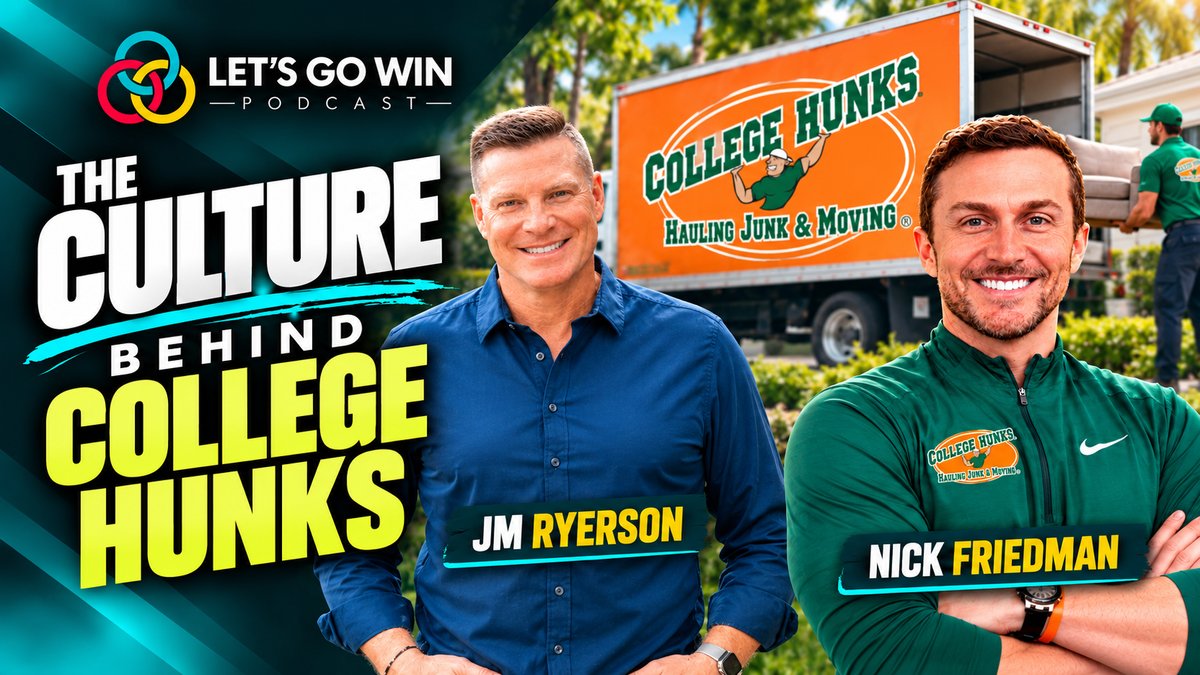
“Culture drives behavior. Behavior drives results.” College HUNKS co-founder Nick Friedman shares how consistent values, repeatable systems, and accountability helped build a business with approximately $300 million in annual sales.
Most companies don’t have a culture problem. They have a consistency problem. They talk about their values, put them on the wall, and expect people to live them. Nick Friedman has spent more than 20 years proving that culture works only when leaders reinforce it every day.
In this episode of Let’s Go Win, JM Ryerson sits down with Nick Friedman, co-founder and visionary behind College HUNKS Hauling Junk & Moving. What started with two college friends and a beat-up cargo van has grown into a business with roughly 200 franchise owners and approximately $300 million in annual sales. Nick calls it a “20-year overnight success,” built through trial and error, resourcefulness, strong systems, and a commitment to developing people.
One turning point came when Nick realized that scaling required more than working harder. He and his business partner had to document their systems, processes, and checklists so the company could operate without them doing everything themselves. That eventually led to franchising, although Nick admits they probably started too early. His advice today: nail it before you scale it.
As College HUNKS expanded, culture became even more important. The company’s purpose is to “Move the World,” both by physically moving people and by making an emotional impact on customers and communities. Its four core values are Building Leaders, Always Branding, Listen Fulfill Delight, and Create a Fun, Safe, Winning Team.
Nick believes one of a leader’s most important jobs is becoming the “Chief Repetition Officer.” Purpose, vision, values, and expectations cannot be communicated once and forgotten. At College HUNKS, core values are reinforced in daily huddles, used in hiring and coaching, and recognized through stories from the team. As Nick puts it, “It’s not what’s on the walls, it’s who’s in the halls and who’s in the homes.”
Culture also needs accountability. Nick and his business partner learned to balance what they call “Sesame Street and Wall Street.” Leaders can care deeply about people while still expecting strong performance. On strong teams, leaders hold people accountable. On championship teams, people begin holding one another accountable.
That foundation mattered during difficult periods, including the 2008 housing collapse and the uncertainty of COVID. Rather than wait for conditions to improve, Nick’s team focused on what they could control: converting more leads, serving customers better, generating referrals and reviews, developing their people, and becoming more resourceful.
Resourcefulness may be even more valuable in the age of AI. As information becomes available to everyone, Nick believes the advantage will belong to people who can connect the dots, use the tools around them, and turn knowledge into action.
The College HUNKS story shows that sustainable growth rarely comes from one breakthrough. It comes from systems, people, accountability, repetition, and a culture that keeps working when the founder isn’t in the room.
Key Takeaways
- 1
Culture requires consistency. Values become meaningful when leaders reinforce them through everyday behavior.
- 2
Become the Chief Repetition Officer. Communicate your purpose, vision, values, and expectations until they become part of how the team works.
- 3
Nail it before you scale it. Build repeatable systems and processes before expanding rapidly.
- 4
Pair culture with accountability. Caring for people and expecting strong performance can go hand in hand.
- 5
Focus on what you can control. When markets change, resourceful leaders adapt.
- 6
Turn information into action. As AI makes knowledge more accessible, creative problem-solving and execution become a greater advantage.
Ready to stop reading and start winning?
Book a strategy call with JM and get a personalized roadmap for your next level.